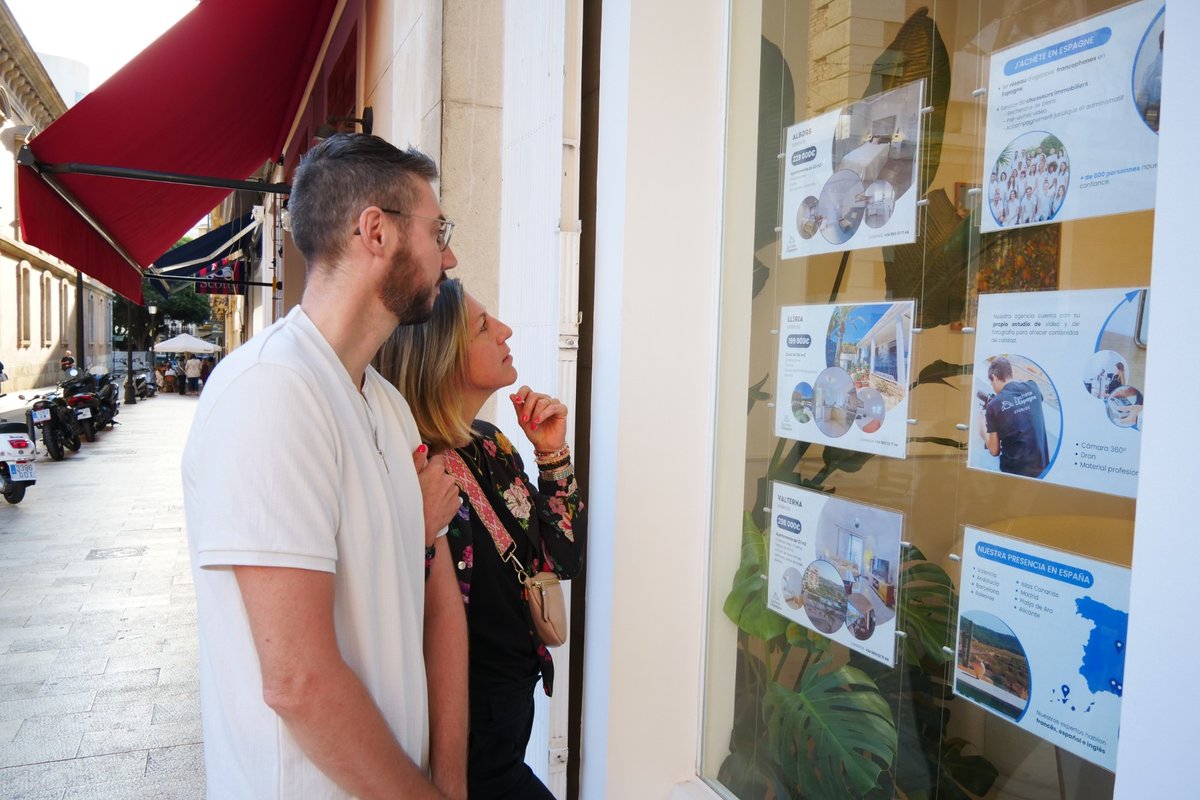
Buying property in Spain with a mortgage: the steps and the traps
 Alveo Finance · Published 21 October 2026 · 6 min read · Lire en français · Leer en español
In short
A financed purchase in Spain follows a set order: agreement in principle, deposit contract, valuation, bank offer, the 10-day period required by Spanish Law 5/2019, notary. The classic trap is to commit before the financing is secured.
A financed purchase in Spain follows a set order. First you check what you can borrow, then you reserve the property and sign a deposit contract (contrato de arras) with a payment. The bank values the property and issues its offer, the 10-day period required by Spanish Law 5/2019 before signing follows, and you then sign the purchase and the loan on the same day at the notary. Most money lost along the way comes from a commitment made before the financing was secure.
The steps, in order
1. Find out what you can borrow
Before you start viewing, put figures on your budget: the likely loan-to-value (up to 75% of the price for a non-resident, up to 80-90% for a resident), your own funds, the buying costs and the monthly payment. The simulator does this in 3 minutes and sends you a detailed PDF. An adviser then checks whether your file is feasible.
2. Get your NIE and open a Spanish bank account
The NIE, the foreigner identification number, is required to buy and to borrow. Apply early, at the Spanish consulate in your country or in Spain: waiting times for an appointment vary widely from one city to another. Alveo Finance does not handle this step. The Spanish account will take the loan repayments and is usually opened with the lending bank.
3. Reserve the property
Once you have found the property, the agency often proposes a reservation contract with a small payment, which takes the property off the market for a few days. Read what it says about refunding that payment if the financing falls through.
4. Check the property
Ask for the nota simple, the extract from the land registry. It shows the owner, and any mortgages and court attachments (embargos) on the property. Also check that the building is legally compliant and that the seller is up to date with the community fees and the local property tax (IBI).
5. Sign the deposit contract (contrato de arras)
The deposit contract binds both parties with a payment, often around 10% of the price, and sets a date for the signing at the notary. Penitential arras (arras penitenciales), provided for in the Spanish Civil Code, work as a paid way out: if you withdraw, you lose the deposit; if the seller withdraws, they pay you back double.
6. Submit the loan application and have the property valued
The bank has the property valued (tasación) by an approved firm, at your expense. The figure matters: the loan-to-value is calculated on the lower of the price and this valuation.
7. Receive the offer and allow the 10-day period
The bank gives you the FEIN (the European Standardised Information Sheet, or ESIS), the FiAE (the Standardised Warnings Sheet) and the draft contract at least 10 calendar days before the signing. This is the 10-day period required by Spanish Law 5/2019 before signing: build it into the completion date in your arras contract.
8. See the notary no later than the day before
The notary you choose sees you free of charge, no later than the day before the signing, answers your questions about the loan and records this in a formal statement (acta). Without this meeting, the loan cannot be signed.
9. Sign the purchase and the loan
On the same day, before the same notary, you sign the sale deed (escritura de compraventa) and the mortgage deed. The bank pays the loan funds to the seller, and you pay the balance and the costs.
10. Pay the purchase tax and register the property
Transfer tax (ITP) on a resale property is declared and paid to your region's tax office within a short period after the signing. The deed is then recorded at the land registry. Amounts and rates by region are in our article on the costs of buying property in Spain.
The most expensive traps
Signing the arras without a financing agreement
If the bank turns you down or takes too long, and the notary date arrives, you risk losing your deposit. Two protections: get an agreement in principle from the bank before you sign, and negotiate a financing clause that refunds the deposit if the loan is refused. Set the notary date with your coordinator, who knows the timelines of the bank you are applying to.
A valuation below the price
If the tasación comes in below the price, the bank lends less and the gap is added to the cash you put in yourself. Keep a reserve, or renegotiate the price with the report in hand.
Leaving the costs out of the budget
Banks do not usually finance the buying costs. A budget based on the price alone falls short at the signing.
Applying for the NIE too late
Without an NIE you cannot sign. An appointment that falls after the arras date pushes back the whole timetable.
Leaving the currency transfer to the last minute
If your savings are in pounds, dollars or another currency, the euro sums due at the arras and the signing are fixed, but their cost to you is not. Plan your transfers well ahead of both dates.
Forgetting the withholding on a non-resident seller
If the seller does not live in Spain, you must withhold 3% of the price and pay it to the Spanish tax agency within one month of the sale, using form 211 (modelo 211). Without this withholding, the property remains security for the seller's tax. The notary will remind you: include it in the price breakdown.
Ignoring charges on the property
An uncancelled mortgage or unpaid community fees show up on the nota simple or with the administrator of the community of owners. Check both before the arras.
What Alveo Finance handles
Your adviser studies feasibility and stays with you until the mandate is signed. Your coordinator builds the file, tracks the deadlines from the arras to the signing and is your day-to-day contact. Your broker presents the file to our partner banks (more than 10 banks, more than 100 bank contacts), negotiates with the banks and oversees compliance. We order the valuation and coordinate the meeting with the notary. We handle neither the NIE nor translations.
Official sources
- Law 5/2019 of 15 March on real estate credit agreements (BOE): article 14.1 (documents handed over 10 days before the signing), article 15.3 (meeting with the notary no later than the day before).
- Penitential arras: Civil Code, article 1454.
- NIE: Royal Decree 1155/2024, article 205 and the Ministry of the Interior; no purchase or mortgage is recorded at the land registry without the parties' tax number: Mortgage Law, article 254.2.
- Valuation: Law 5/2019, article 13, Order ECO/805/2003 and Royal Decree 775/1997.
- 3% withholding on a non-resident seller: Agencia Tributaria.
Legal information. Alveo Finance Management, S.L. (tax ID B27611433), Calle Purísima 5, 33, 46001 Valencia, Spain. Mortgage credit intermediary registered with the Banco de España register of mortgage credit intermediaries under code E756 (registered on 6 July 2026), check it here. Supervisory authority: Banco de España. Non-tied intermediary; our advisory service is not independent within the meaning of Royal Decree 309/2019. Remuneration: a €500 processing fee, then 1.15% of the loan amount with a minimum of €3,490. We also receive a fee from the lending bank, shown in the FEIN. Complaints: finance@alveo.co, then the Banco de España Market Conduct Department. Professional liability insurance: Lloyd's Insurance Company, S.A. This article is for information: it is not a loan offer, which depends on the bank's creditworthiness assessment and binding offer.