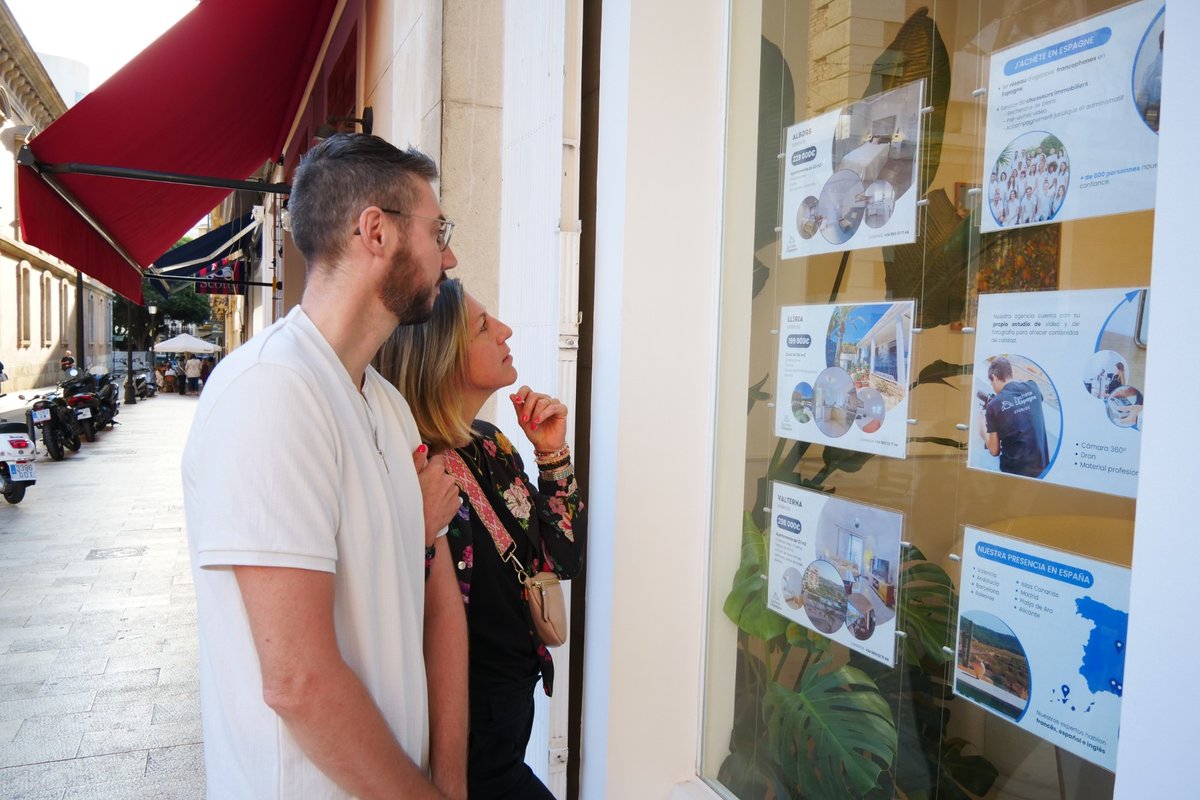
Buying a holiday home in Spain with a mortgage
 Alveo Finance · Published 21 October 2026 · 6 min read · Lire en français · Leer en español
In short
A holiday home in Spain is financed like any non-resident purchase: banks lend up to 75% of the price. The difference lies in the yearly budget, which many buyers underestimate.
A holiday home in Spain is financed in the same way as any purchase by a non-resident. The bank lends up to 75% of the price, over a term that depends on your age, and checks that your income covers the monthly payment on top of your outgoings in the country where you live. Many buyers underestimate a different figure: what the property costs each year, mortgage included.
What the bank will lend
For a holiday home, you are usually not tax resident in Spain. Banks then lend up to 75% of the lower of the price and the valuation (tasación). Your deposit covers the rest of the price and all the purchase costs, which are set out in our article on the costs of buying property in Spain.
The bank looks at your income in your home country and at the commitments you keep there: your mortgage or rent at home, your other loans. The Spanish monthly payment comes on top of all that. Our article how much can I borrow in Spain explains how the calculation works.
The yearly budget
Beyond the mortgage payment, a holiday home in Spain comes with fixed costs, whether you spend two weeks or six months there.
| Item | What you need to know |
|---|---|
| Property tax (IBI) | Annual municipal tax calculated on the cadastral value of the property. Each municipality sets its rate between 0.4% and 1.10% of that value for urban property, and some can add surcharges. |
| Community fees (comunidad) | Upkeep of the shared areas, pool, gardens, caretaker: they vary widely from one development to another. Ask for the amount and the minutes of the latest owners' meetings before you sign. |
| Insurance | The bank requires insurance covering the mortgaged property. It can offer its own policy: the law lets it lower your rate if you take that policy, and forbids it from making the policy a condition of the loan. |
| Non-resident income tax | Even if you never let the property, a non-resident declares each year a notional income equal to 2% of the cadastral value (1.1% if that value was revised recently). It is taxed at 19% if you live in the European Union (Ireland included), Iceland, Norway or Liechtenstein, and at 24% if you live elsewhere, the UK, the US, Canada and Australia included, using form 210 (modelo 210). A royal decree-law of 6 October 2026, not yet validated by the Spanish Congress as of 20 October 2026, provides for a new scale from 2027. |
| Water, electricity, upkeep | Utility contracts run all year round. Add the upkeep of a garden or a pool if the property has one. |
Alveo Finance does not calculate non-resident income tax or the tax on any letting income. Ask a tax adviser to work them out. We do calculate the total cost of the purchase: price, transfer tax (ITP) or VAT, deposit (arras), notary, land registry, valuation (tasación) and our fees. We also receive a fee from the lending bank; its amount is shown in the FEIN.
What if you let it for a few weeks a year?
Many buyers count on a few weeks of letting to cover part of the costs. Take two precautions before you put that rent into your budget. Holiday letting is regulated municipality by municipality and region by region, with registrations to make and, in some places, outright bans: check what applies to the property you have in mind before you sign the deposit contract (contrato de arras). And a bank rarely takes future, uncertain rent into account when it works out how much it will lend you.
How long you can stay: the 90/180-day rule
If you hold a UK, US, Canadian or Australian passport, owning a home in Spain does not change how long you may stay there. You need no visa for a short stay in the Schengen area, but short stays are capped at 90 days in any 180-day period. The count is rolling: on each day of your stay, look back over the previous 180 days. Days spent in France, Portugal or any other Schengen country count towards the same 90. Irish citizens are EU citizens, so the limit does not apply to them.
The European Commission publishes a short-stay calculator online, and since 10 April 2026 the EU Entry/Exit System (EES) has been registering non-EU nationals on a short stay. To stay longer, you need a long-stay visa or a residence permit under Spanish national rules. Buying property no longer leads to residence on its own: Spain abolished its investor visa, known as the golden visa, with effect from 3 April 2025. Plan your visits and any letting periods around the rule. If you want more time in Spain than it allows, the question becomes whether to move there, which also changes how the bank sees you.
Resident or non-resident: when your status changes
If you plan to settle in Spain within a few years, the way the bank treats you will depend on where you are tax resident when you apply. A Spanish tax resident can borrow up to 80-90% of the price. Once you have moved, you can also renegotiate your mortgage with your bank.
Questions to settle before you start looking
- How much deposit can you put in without touching your emergency savings?
- What monthly payment can you carry on top of your current outgoings?
- What yearly budget are you prepared to spend on a home you use for a few weeks?
- Do you plan to let it, and does the municipality allow it?
- How many days a year do you expect to spend there, and does that fit the 90/180-day rule if it applies to you?
The simulator answers the first two in 3 minutes and sends you a detailed PDF with the total cost of the purchase.
Official sources
- IBI: consolidated text of the Local Finances Act, article 72.
- Notional income of non-residents: Agencia Tributaria; consolidated text of the Non-Resident Income Tax Act, articles 24.5 and 25.1.a.
- Royal Decree-law 29/2026 of 6 October 2026 (BOE-A-2026-20823), awaiting validation by the Spanish Congress.
- Law 5/2019 of 15 March on real estate credit agreements (BOE): article 17 (tied sales banned, combined sales allowed).
- Schengen Borders Code, Regulation (EU) 2016/399 (EUR-Lex): article 6.1 (stays of no more than 90 days in any 180-day period, counting the 180 days before each day of stay).
- Regulation (EU) 2018/1806 (EUR-Lex), Annex II: countries whose nationals need no visa for short stays, including the United States, Canada and Australia; the United Kingdom was added by Regulation (EU) 2019/592.
- European Commission, Migration and Home Affairs: border crossing (short-stay calculator, Entry/Exit System in full operation since 10 April 2026, long stays subject to national rules).
- End of the investor visa: Organic Law 1/2025 of 2 January, final provisions 21 and 38, with effect from 3 April 2025.
Legal information. Alveo Finance Management, S.L. (tax ID B27611433), Calle Purísima 5, 33, 46001 Valencia, Spain. Mortgage credit intermediary registered with the Banco de España register of mortgage credit intermediaries under code E756 (registered on 6 July 2026), check it here. Supervisory authority: Banco de España. Non-tied intermediary; our advisory service is not independent within the meaning of Royal Decree 309/2019. Remuneration: a €500 processing fee, then 1.15% of the loan amount with a minimum of €3,490. We also receive a fee from the lending bank, shown in the FEIN. Complaints: finance@alveo.co, then the Banco de España Market Conduct Department. Professional liability insurance: Lloyd's Insurance Company, S.A. This article is for information: it is not a loan offer, which depends on the bank's creditworthiness assessment and binding offer.